
Matalija poppy, Romneya colteri.
After a slow morning in the Sierra San Pedro Martir, I made my way back down to the Transpeninsular Highway. It ended up being a challenging communication day, as an unexpected situation was unfolding at home. It turns out that a lot of Baja California Norte has either no or very weak network coverage, especially south of El Rosario through the Central Desert. It was almost impossible to find out details about what was happening at home, and when I got to Laguna Chapala, I almost went back up to Phoenix via Mexico 5 along the Gulf Coast.
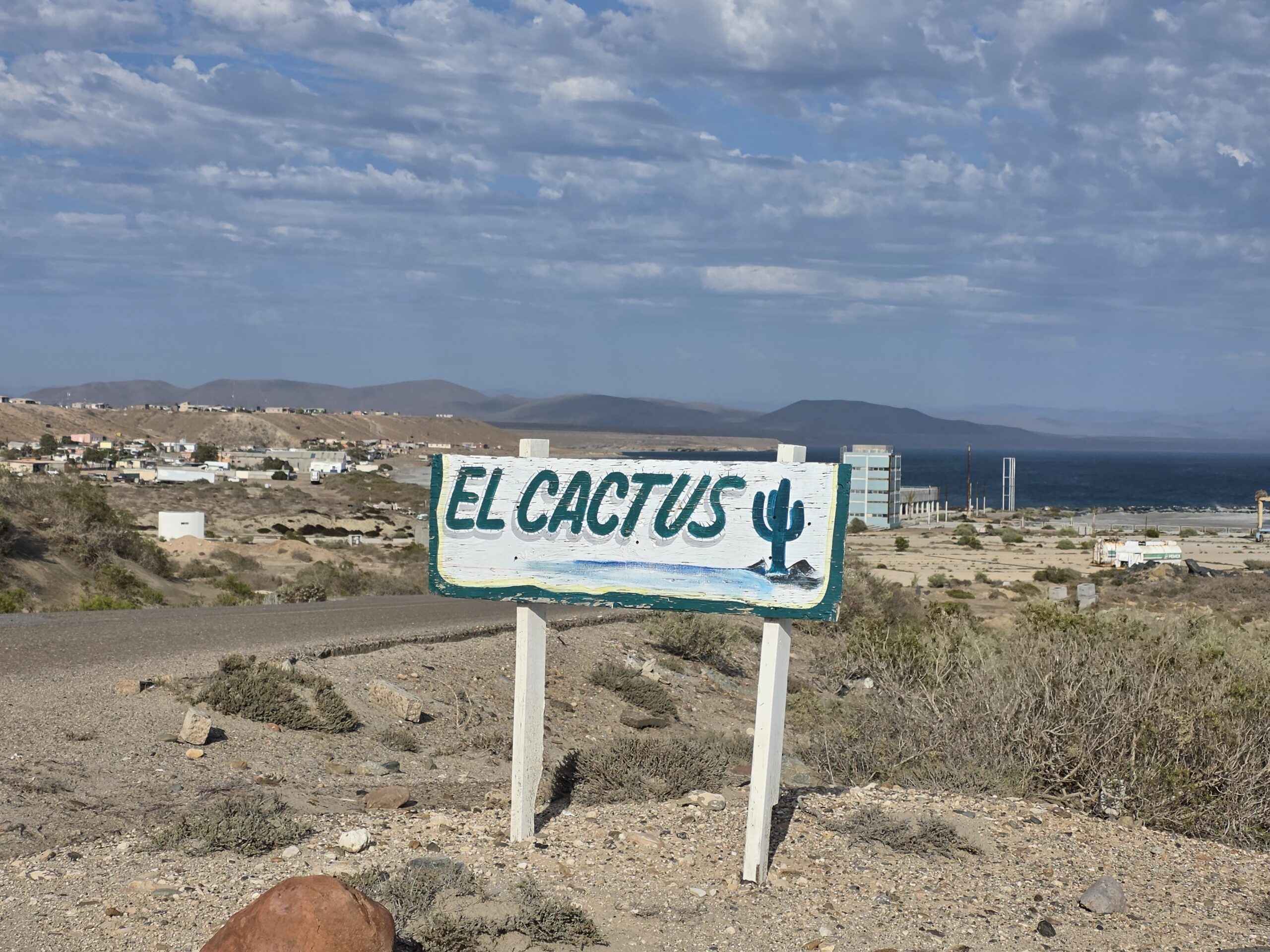
I made brief contact from a tiny little internet shack and convenience store at Laguna Chapala, however, and was told there was no need to come home, so I continued on, with the goal of camping on the beach in Santa Rosalillita, a tiny fishing village on the Pacific coast with a wind-blasted, primitive campground called El Cactus.

On the way back to the main highway, you can see small Pachycereus pringlei “farms” around San Telmo. These cultivated cardon sahueso are about 100 miles north of their natural range in Baja, south of El Rosario.

I arrived at the campground in Santa Rosalillita not too long before sunset, and it was (as almost always) ferociously windy. I pitched the tent behind a tall dune, trading level ground for the windbreak. Beach camping in Baja often involves putting up with constant wind and lots of sand getting in the tent.
Santa Rosalillita is in a small bay, somewhat protected from the immediate ferocity of the Pacific.

As is often the case along the Pacific coast of Baja, the view is to the south or southeast, because most towns and many accessible areas are on south-facing bays.

Santa Rosalillita has an interesting recent history due to an ambitious project launched in 2001 by FONATUR (the Mexican federal government tourism agency) which was called La Escalera Nautica. This was a $1.9 billion boondoggle that promoted the idea of creating several marinas in Baja and along the mainland coast, and in Baja the main idea was to make it possible for boaters to take out in Santa Rosalillita and put in on the Gulf of California side of the peninsula, at Bahía de Los Angeles (and vice versa). The road to town was paved, and many turnouts were added for boat trailers. In Santa Rosalillita itself, they tried to create a harbor and marina, and a huge boat complex, warehouse, fueling station, etc. were built. The problem was that, within six months, the “harbor” had already started filling in with sand, and the bathymetry just didn’t lend itself to a stable situation, marina-wise.
The picture below was taken in 2015. The entire complex is abandoned and rusting out now, like something from a post apocalyptic movie. The Escalera Nautica project was finally abandoned altogether in 2009, much to the relief of marine conservationists.

When I learn more Spanish, I really want to ask the people who live in Santa Rosalillita (approximately 200 people) what they think of all of this. I’m sure they were promised quite the boom economy. There are several other attempts at “promoting tourism” in many parts of Baja that are remote from the northern well-established tourist areas around Ensenada, as well as the huge developments in Los Cabos. But what developers and promoters often fail to realize (or don’t tell funders) is that the weather is brutal. Windy, often stormy, subject to sudden changes, cold, and fickle. The roughness is one of the things I love, but it really does not draw the tourists so much.
There’s some great botanizing around Santa Rosalillita, including Cochemiea blossfeldiana shown below. But I didn’t stay longer than overnight, and wanted to get back on grid to find out about what was happening at home, so the next day I headed south.


Crossing into Baja California Sur near Guerrero Negro, I figured I would try camping along the Gulf coast at Playa la Perla, one of my favorite beaches, on Bahía Concepción. I knew it gets hot in summer, but I wasn’t aware that a major heat wave was settling in. More in the next post.
Leave a Reply