
From June 10th to July 27th this year, I was in Baja California Norte y Sur.
It was a working trip, since I had a lot of things to finish up re: editing, and a couple papers to submit. But what a setting from which to work! I recently upgraded to an unlimited Verizon data plan, which works for free in Mexico, so that definitely made it easier.

I almost always cross at Tecate, which, in spite of being very close to both Mexicali and Tijuana, still has a more laid back and more easily navigable feel. It takes about five hours to get to Tecate from Phoenix, and crossing is usually painless. I have never really been delayed by Mexican customs, entering the country. It is very straightforward to park along a nearby street, and walk back to the immigration office, obtaining the required tourist visa. For six months, the charge is 983 pesos, or $55 US. The office is currently only allowing payment by card, so they’ve definitely streamlined the process.
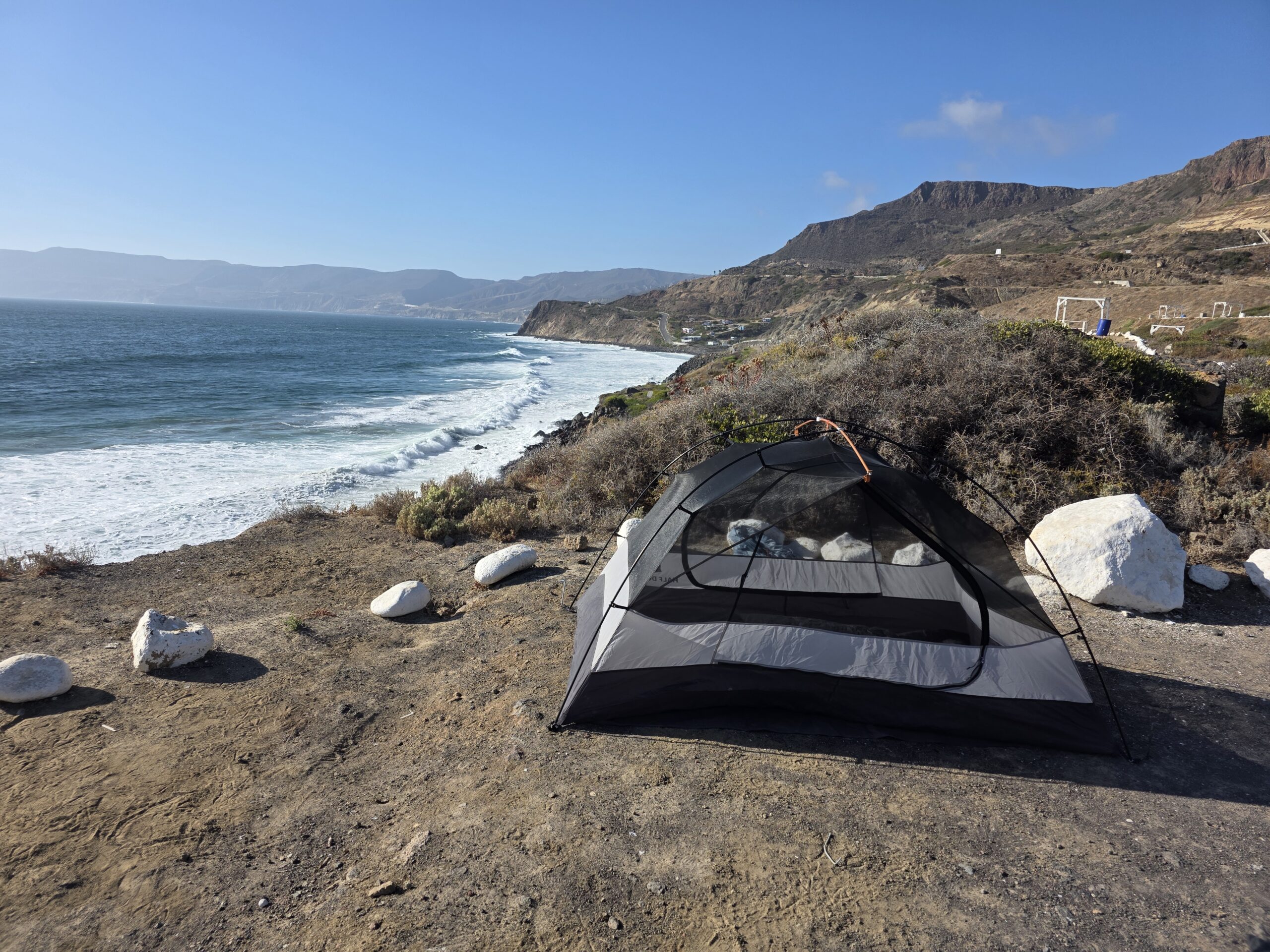
Sometimes I stay in Tecate for a night or two on the way in, but this time I drove down to the Pacific Coast and camped at Playa Saldamando. It’s gone up to about $30 a night (500 pesos), but it’s still a bargain with camping right on the ocean, near lots of great restaurants and other features, and there’s strong internet.

Playa Saldamando marked in the red tent symbol above.

It felt liberating to be out of the US, to be surrounded by cool sea air, and to bask in the sound of the waves. As is often the case, the campground was nearly deserted, although a young couple set up near my camp and was blaring some godawful dance music out of the car stereo for a while. They quieted down around sunset though.
There’s a lot of botanizing right there at the campsite, since the California Floristic Province Baja California flora is already present, not too far south of the US border. Main taxa include Bergerocactus emoryi, Echinocereus maritimus, Ferocactus viridescens var. littoralis, Dudleya brittonii, Agave shawii, and Cochemiea dioica.

The green form of Dudleya brittonii in flower. The chalky white form is mostly on higher, inaccessible cliffs, probably because it has been collected out of the wild.

Large old Agave shawii.

Cocehmiea dioica, by far the most common Cochemiea on the peninsula.

A large old clump of Echinocereus maritimus.

Ferocactus viridescens subsp. littoralis.

Bergerocactus emoryi backlit by the sunset.
In many parts of the peninsula, the effort and the infrastructure is just not there to haul out destroyed vehicles or campers.

A fixer upper.

I was in the tent and asleep soon after sunset. The only drawback to Playa Saldamando is that it is right next to Highway 1, the main transpeninsular highway, and sometimes the incredible noise of semis using their engine as a brake continues periodically throughout the night. This night, however, the tide was high, and the hypnotic sound of the waves completely blocked out all of the highway noise.
This was the best possible start to the trip. Peaceful, quiet, beautiful, and a great night’s sleep by the ocean.
Leave a Reply